12/9/21

The Largest Amish Settlement in the South

Amish Heritage Farm Museum


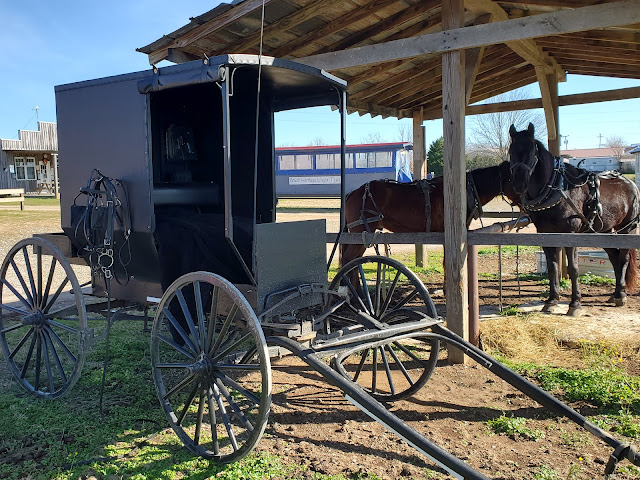
In 1944, a small group of Swartzentruber Amish (one of the most conservative subgroups of Old Order Amish), left Mississippi and settled in Ethridge, Tennessee, for its good farmland. The area is now home to over 300 Amish families, and they welcome tourists to their homesteads to shop their goods (but they ask that you do not take any photos; their religion prohibits them from drawing attention to themselves). You can drive around the area on your own and/or take a wagon tour provided by non-Amish businesses. Pick up a map at one of the welcome centers or just look for the hand-written signs in front of the homes. Watch out for buggies on the roads, especially away from the farms on the main roads!

One of Tennessee’s oldest Amish farms (1944) is now the Amish Heritage Farm Museum. (Call before going. It was closed when we went, even though their website said it should be open.) This is a non-Amish business and you can take photos here. Even with it closed, you can still see some of it. Admission to the museum includes a horse drawn wagon tour through the Amish area.


Confusingly, there are two businesses called Amish welcome centers located almost next to each other on Highway 43. Tickets to the Amish Heritage Farm Museum are only available at the “Amish Heritage Welcome Center” (4001 Hwy 43). You can also shop and take a horse drawn wagon tour from “The Amish Welcome Center” (3943 Hwy 43), which is what we did since the other one was closed. The tours go out as people show up. We had just two of us for our tour and took a small, covered wagon. On a previous visit, as part of a large group, I rode in a much larger wagon. The tours include stopping at several of the farms and last about an hour and a half.


There are several one-room schoolhouses in the community. The children running around and playing outside their schoolhouses make a scene that looks like a 19th-century painting (I wish I could have taken a photo). The teachers are young, unmarried girls who have completed 8th grade (Amish education ends at 8th grade). You can see “his and hers” outhouses beside the schools. The Amish hold church in their homes, so there are no church buildings.

Most families have many children (our tour guide said nine children on average, but some have up to twenty). When the parents get old they sell their farm to one of the children who then builds a new house (sometimes connected to the parents’ house) and the parents stay in their old house.

They don’t have cars, tractors, electricity, or running water. They don’t use pneumatic or hydraulic power in their shops, but I was surprised to see that they do use single shaft diesel engines to run shop equipment (such as in a furniture making shop).
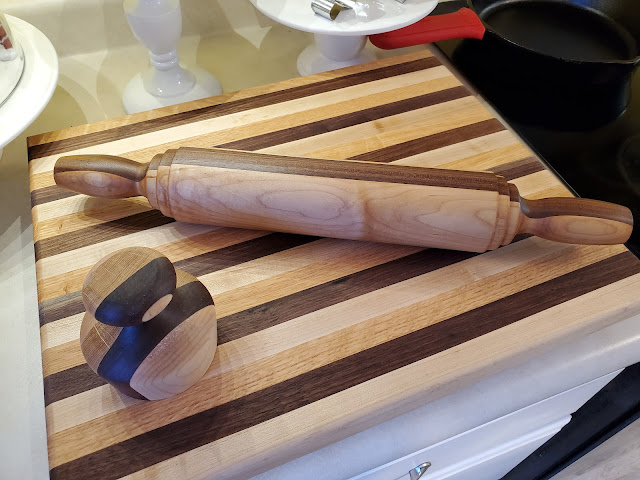
You can find all sorts of items for sale, such as soaps, candles, wooden furniture, candy (including the best peanut brittle ever), quilts, leather goods, rugs, baskets, jams & jellies, pickled foods, and more. The prices are better at the homesteads than at the stores on the highway selling Amish goods. The Amish only take cash though. (There is an ATM inside the Amish Welcome Center.) The homesteads also have honor boxes for payment if no one is available. I bought this beautiful cutting board for less than half the price I've seen similar cutting boards elsewhere, and I got to meet the teenage boy who made it (he signs and dates them on the back). I also bought a biscuit cutter and rolling pin.

Stop in at Bob’s CafĂ© for lunch (between the two welcome centers). The food is great and the people are so nice. There are several restaurants and plenty of antique stores and markets along highway 43.

Another fun stop is Flowers Creamery, seven miles from the welcome centers. It is a small family-run business (not Amish). They make small batch cheeses (taste some samples) and bottled creamline milk in several flavors. They have a herd of Holsteins and a herd of Jerseys, and they make the cheese from a mixture of the milk from both. They have a nice shop within view of the cows, and they offer farm tours on Wednesdays (call ahead to be sure).


7/29/20

Chase Depot and North Alabama Railroad Museum

The Chase Depot building, built in 1937 to replace the 1908 building

Once again, a memory of an event that seems so recent is proven to be much longer ago by the age of my children. It turns out the last time we visited the North Alabama Railroad Museum was over twenty years ago! Along with two of my nephews, who now have families of their own, we explored the museum and went on a train ride. We got to pull the whistle in the diesel locomotive and explore the baggage and dining cars during the ride. When I visited again recently I found I really didn’t remember that much about the place and, of course, there have been some changes.

Exploring locomotive 484 in 1999. It was built by ALCo for the Delaware Lackawanna & Western Railroad in 1949. It was also used by the Reynolds Metals Company in Sheffield, Alabama. It is still operational and is in the colors and paint scheme of the Nashville, Chattanooga & St. Louis Railway (with the museum's railroad name, Mercury & Chase).

The North Alabama Railroad Museum in 2020

The museum is an all-volunteer organization and is free to visit. (There is a charge for train excursions.) Volunteers are only on site at the museum two mornings per week, but you can visit “every day during normal daylight hours” and explore the outdoor exhibits on your own. Don’t be deterred if the big gates to the parking lot are closed. Park outside the gate and use the smaller pedestrian gate to enter. Information sheets are available in the waybill box on the side of the depot. You can visit the interior exhibits when volunteers are available and when train rides are offered. There is also a viewing platform where you can watch trains pass by on the Norfolk Southern mainline.

Locomotive 213 built by ALCo for Manufacturer's Railroad in 1941. It is operational.

The museum's collection includes a postal car, horse car, diners, sleepers, box cars, flat cars, coaches, baggage cars, a refrigerator car, and much more.


The Memphis & Charleston Railroad Company (M&C) built the first rail line through this spot in 1856. The line came from Memphis, through Decatur and Huntsville, and linked to the Nashville & Chattanooga Railroad in Stevenson, Alabama. There was no depot here at that time. It was probably a water station stop but not a regular stop. (Huntsville, on the other hand, had a large depot by 1860 because it also served as the railroad’s eastern division headquarters). 

As a link in the only east-west railroad through the Confederacy, the M&C was strategically important during the Civil War. The Union captured its eastern headquarters at Huntsville early in the war. Their occupation of Huntsville spared the Huntsville Depot (now one of the oldest depots in the U.S.) and, although many depots and other railroad buildings were destroyed in other towns, the section of line from Decatur to Stevenson was “in excellent condition” at the close of the war. By November of 1865, M&C had the entire line passable again, except for the loss of the bridge over the Tennessee River at Decatur.

In 1887 a second railroad came through the area when the Nashville, Chattanooga & St. Louis (NC&StL) extended its line south to Huntsville. The two lines came to within a few feet of each other at Chase (then called Fearns). 

The yellow dot is the location of Chase/Fearns. By 1892 the NC&StL reached the Tennessee River at Hobbs Island where the train was loaded onto a ferry for the ride to Guntersville (from there it continued by rail to Gadsden). (Photo of 1892 map from the Library of Congress: http://hdl.loc.gov/loc.gmd/g3866p.rr005740)

In 1889, four brothers left Maine for Huntsville and started a successful nursery business on 600 acres of land in northwest Huntsville. In the early 1900s, the Chase brothers bought an additional 900 acres here, where the two railroads nearly met (and came to be known as Chase), in order to expand their shipping business through these north-south and east-west rail lines. By 1906 they had built a brick warehouse for packing and shipping their plants, and in 1908 they built a passenger depot which they leased to the railroads. Because the depot served two railroads, it was a “union” depot, the smallest in the U.S. They added the nursery office building in 1910. The depot was destroyed by fire in 1935, but the Chase family built the current depot on the same site in 1937.


The Chase Depot in 1915 (Photo from Internet Archive Book Images - page 7 of "Wholesale price list : fall and spring, 1915-1916" (1915), CC BY-SA 2.0, https://commons.wikimedia.org/w/index.php?curid=34656754)

The former Chase Nursery office building, built in 1910, now a museum building. (The original ceramic tile roof had to be replaced.)

The former Chase Nursery warehouse is a partial ruin but the museum stores some equipment here.

Henry B. Chase (who became the president of the nursery company) also built a home across the road. He became a prominent Huntsvillian who served as the Mayor of Huntsville (1918-1920) and the first President of the Huntsville Historical Society. He died in 1961 at the age of 91. His nephew then ran the company. 

 Chase home, across the street from the Depot. It is now the Dogwood Manor Guesthouse.

Over the years, the railroads changed hands. The Memphis & Charleston became the Southern Railway in 1898 and then Norfolk Southern in 1982. Norfolk Southern still operates on this east-west line next to the museum. Nashville, Chattanooga & St. Louis became L&N in 1957, then Seaboard System Railroad in 1982, and the line from from Decherd TN to Chase was abandoned in 1985. The nursery went out of business in 1993. (Most of the nursery property now belongs to Alabama A&M University.) The Chase family had already converted the depot into a museum in 1966. With the demise of the north-south rail line, the North Alabama Railroad Museum moved to Chase and bought some of the track and right-of-way. The volunteers rebuilt 3 miles of missing track, so they are able to offer train rides of 10 miles round trip on their own Mercury & Chase Railroad.


A concrete Watchman's Hut, donated by Southern Railway. Huts were located at street railroad crossings and manned by crossing guards.

Sleeper car built in 1949 for the Southern Railway by Pullman-Standard


L&N passenger car

Motor car (maintenance car used by track inspectors) built by Fairmont for the U.S. Army in 1980

Baggage wagons in the museum's picnic pavilion

A loaded baggage wagon in front of the 1908 depot. (Photo from Huntsville Madison County Public Library Digital Archive)

Great Western diner car

Another view of the Chase Depot

Caboose built in 1947 for Southern Railway

7/21/20

Old Brick Kiln at Brickyard Landing Decatur


I saw a picture of this kiln posted on Glenn Wills “Forgotten Alabama” Facebook page (I love his books). I had to drive right over to check it out the same day. I had no idea this is “hiding” right behind the Ingalls Harbor Pavilion in Decatur. It is the only remaining kiln from the Alabama Brick & Tile Company, which formerly occupied this site (now occupied by the Brickyard Landing Marina). 


Patio at the Brickyard Landing Marina shop - The kiln is on the edge of the shop's parking lot

The Alabama Brick & Tile Company was established here, on the banks of the Tennessee River, in 1897. It operated many kilns; a sketch on a company-branded thermometer shows eight of them. 


Photo from Decatur Parks & Recreation

When the brick plant was razed, one kiln was left as a historical monument, although there is no sign posted. It is open and accessible to the public.


The beehive kilns were made of brick with domed roofs (similar to the beehive Coke Ovens at West Blocton Park).

The kiln dome

The brick making process began with a boat crew piloting a small tugboat and barge upstream to alluvial clay deposits along the riverbank. A 1964 TVA report lists the company’s clay pit as located at river mile 333.4 R, which puts it about where Aldridge Creek empties into the river at Ditto Landing in Huntsville. 


Bridge over Aldridge Creek where the creek joins the Tennessee River. Alabama Brick and Tile Company’s clay pit was in this area. (The bridge was built in 1925. It’s now closed.)

The boat crew consisted of just two employees: the boat pilot / machine operator and the deckhand / locomotive operator. A National Labor Relations Board Decision in 1948 described their duties as consisting of “running the barge in which the raw clay is transported to the plant, and operating the dragline, the locomotive and other machinery by means of which the clay is taken from the bank and loaded on the barge.” The daughter of a boat crew employee said they would be gone about four days at a time and sleep and cook on the boat. They returned with the clay to the company’s “major freight terminal,” which was established at the plant in 1938 with a dock, slip, crane, cable car, and electric hoist used to transfer the clay. At that time,  the president of the company was W. B. Neher. His son, Herbert Neher, was employed “in a general maintenance capacity, and the record indicates that he may be called on to perform some managerial functions.”

I haven’t been able to find many other details about the company or their brick making process. The bricks would have been shaped by molding or extruding, dried, and then stacked in the kiln.  Presumably, the carts currently in the kiln were used for moving the bricks in and out.

The two large openings in the kiln were for loading and unloading the bricks. 

Carts currently inside the kiln

The bricks were stacked in patterns (depending on the type of clay and type of brick surface), which allowed for the flow of the heated air from the top of the kiln, down through the perforated floor, into an underground flue, and out the chimney. The chimney was, apparently, torn down. 


Perforated floor of the kiln

The beehive downdraft kiln directs the hot air up the dome and down through the floor for even and efficient heating.

The heat was generated by burning coal in the ten fireboxes evenly spaced around the kiln. The fires would have been tended around the clock for 4 to 5 days. The company spent over $36,000 on Alabama-mined coal for one year of production in 1948. The walls of the kiln are several feet thick for insulation.

The thickness of the wall can be seen in the archway

Kiln temperatures, as well as the rate of heating and cooling, are crucial to brick making. In 1922, the “Brick and Clay Record” reported that Alabama Brick & Tile had recently installed pyrometer equipment as an aid in the burning operation. (Pyrometers measure very high temperatures.)


One of ten fireboxes on the kiln

More fireboxes on the kiln


The bricks were removed from the kiln after cooling. One employee’s work consisted of “pitching brick from the kiln to the wheelers, directing the wheelers to the proper part of the kiln to pick up their loads, keeping count of the loads of brick and checking the time of the wheelers.” He was paid at piece rates, and his piece rates were higher than those of the wheelers. 

Some of the brick sold was shipped by the adjacent railroad; some was hauled by trucks owned by the brother of the company’s president; and a small quantity was picked up by the customers at the plant.


This building, near the kiln, looks like it may have been part of the brick plant (and/or built with their bricks)

Brickyard Landing waterfront condos near the kiln

A second condominium complex, Lighthouse Landing, was proposed to be built next to the Brickyard Landing condos back in 2007, and the developer said he would register the kiln with the National Register of Historic Places. As far as I can tell, his development deal fell through (there is a Home2 Suites by Hilton on the site now) and the kiln has not been added to the register. The Decatur Parks and Recreation Department has included the kiln in their recent “Where Am I?” online scavenger hunt.

Another beautiful view from Brickyard Landing