8/6/19

River City: Evansville, Indiana

A mural on Main Street

River views, a charming Main Street, and a cat café selling 16 different types of macarons – there’s really no need to say any more...but I will.


Evansville is situated on the Ohio River in the southwest corner of Indiana, right next to Kentucky and Illinois. It only came onto my radar last month when my kids told me it was less than a 4½ -hr drive from Huntsville, and they were attending a concert at the arena there. I knew absolutely nothing about this city, so I decided to go along. I had such a great time exploring the city over three days, which was not nearly enough time to experience all it has to offer. I didn’t even make it to the Dream Car Museum! I’m definitely going back.

Evansville Convention & Visitors Bureau on the riverwalk in a repurposed park pagoda
Downtown Riverwalk

Nowadays, it seems that just about every city has a thriving/revived and walkable downtown, and Evansville does not disappoint. In addition to gorgeous historic architecture, a riverfront promenade, and prehistoric Native American mounds, Evansville has attractions I would not expect to find in a city of this size (less than 120,000 people), including a 45-acre zoo, an 11,000-seat arena, an art museum with a very impressive permanent collection, and a new (2017) land-based Tropicana casino.


Downtown is full of interesting architecture and monuments. The Old Vanderburgh County Courthouse was built in 1888 on the site of a basin in the filled-in Wabash and Erie Canal. A tunnel leads to the Old Vanderburgh County Jail across the street, which was modeled after Liechtenstein Castle.


Old Vanderburgh County Courthouse
Old Vanderburgh County Jail
Koch Family Children's Museum in the old Art Deco-style library building

The old post office and customs house (now an event center)

Main Street has plenty of restaurants in the historic buildings, including Arazu (Mediterranean food)

At River Kitty Cat Café on Main Street you can watch the kitties on the other side of the glass while enjoying macarons (delicious!), coffee, smoothies, hummus, and more. You can also spend time with the kitties inside their enclosure.

River Kitty Cat Café on Main Street
Kitties napping in the glass-enclosed kitty lounge
Almond, Coffee Caramel, Creme Brulee,
and White Chocolate macarons

Fun on Main Street

The Bru Burger Bar is located in this fabulous Streamline Moderne-style Greyhound bus station built in 1938.


The Evansville Museum of Arts, History and Science is much larger than I expected and includes art galleries, a hands-on children's science section, an immersive theater and planetarium, an anthropology gallery, and an old Evansville city street recreation. The history collection includes furniture made by Abraham Lincoln and objects owned by his parents. The art collection includes American and European works from the 16th century to the present. The museum is located right on the river, so there is a nice view from the outdoor sculpture garden. 


The Transportation Center is also on the campus of the Evansville Museum of Arts, History and Science.


Angel Mounds State Historic Site is also located on the Ohio River, about 10 miles east of downtown. Here you can see the mound remains of a town built by people of the Mississippian culture and occupied from 1100-1450 AD. The site includes a small museum and an outdoor recreation of a section of the impressive wall that once surrounded the town. Inside the museum you can see how this type of wall was built.


I took a walk through the Tropicana Evansville Casino to see all the colorful lights. I tried to play a quarter machine but it didn't take quarters (cards only)! The casino complex includes several restaurants and hotels, along with an event space with floor-to-ceiling views of the river.


Imagine having your local library in a Victorian gothic building like this! The Willard Library was built with private funds in 1885 and is one of the oldest libraries in the midwest. The interior features lots of beautiful oak wood, and the children's section (in the basement) has modern stained glass windows. The library is supposed to be haunted by the Grey Lady. You can even watch for her on the Willard LibraryGhostCams


I visited the Mesker Park Zoo & Botanic Garden on a very rainy Monday morning, but the grounds were still beautiful. It was founded in 1928 and has a few artifacts on display from its early days. However, it is a thoroughly modern zoo with large enclosures surrounding a central lake. Animal exhibits are grouped by region, including an indoor Amazonia rainforest. My favorite animal was the prehensile-tailed porcupine, native to South America. The zoo also has a carousel, pedal boat rides, a tram, and beautiful views of the lake area.


I always enjoy exploring historic districts and Evansville has 425 buildings in its Riverside Historic District. 


One of the buildings in the Riverside Historic District is the Reitz Home Museum, where I had a tour guide all to myself on my Sunday afternoon tour. I have been on a lot of home tours and this one was particularly interesting. It had several things I had not seen in other homes, including stained glass windows on hinges with electric lights behind them for dark days, a still-functional electric servant call bell, and flame-heated clothes drying racks in the basement. (The guide said the Biltmore has such a contraption too, but I don't remember seeing it on the tour I took there.) The original owner of the home was in the lumber business, and every room in the home has a different parquet pattern in the wood flooring.


One famous house that is not located in the historic district is the house from the opening credits of the 1990's TV show Roseanne.


Here are some more pictures of the architectural (including Mid-Century Modern) and art sights around downtown.


The sights I didn't get to see on this trip include the Dream Car Museum, Evansville African American Museum, Evansville Wartime Museum, and the USS LST-325 (a World War II-era naval landing ship, which also sails to other ports in the summer, so I have been able to tour it in Huntsville).

6/10/19

Atlanta Cyclorama


Cyclorama: “A large pictorial representation encircling the spectator and often having real objects as a foreground.”

I admit that the first time I saw the Atlanta Cyclorama building (next to the Atlanta Zoo at that time), I thought it was some sort of bicycle track (cyclodrome/velodrome). So, in all our visits to Atlanta, I never took my kids to see it. In my defense, it wasn’t all that far-fetched since Atlanta had recently hosted the 1996 Summer Olympics. Many years later, when I found out it is actually a painting that depicts the July 22, 1864 Battle of Atlanta, I wasn’t very enthused about standing in a room and looking at a single painting of a battle, even if it was a 360° painting.

In 2017, I read an article about the painting being removed for restoration and relocation. In learning a little more about it (and now being more interested in art), I was anxious to see it back on display. In 2019, the new Lloyd and Mary Ann Whitaker Cyclorama Building at the Atlanta History Center opened and I finally got to see it. None of the information I previously read did it justice (and neither can my photos)!


Many things surprised me about the Atlanta Cyclorama: Its incredible height, its age and provenance, the illusion of depth provided by the diorama, its physical structure, and the fact that it depicts a major Union victory (while being displayed in the South since 1892).

The painting is over 4-stories tall and you get to view it from two different levels: a 12-foot-high platform and floor level. The restoration took it back to its original height of 49 feet (from 42 feet) and circumference of 371 feet (from 359 feet) after losing some height and a couple of narrow strips during its earlier moves.

The bald eagle is Old Abe, the mascot of the 8th Wisconsin infantry regiment, which was not involved in the battle, but the artists likely included it as a sort of Wisconsin signature.

In 1886 the American Panorama Company in Milwaukee hired seventeen German artists to paint The Battle of Atlanta, and it was completed in just five months. A lot of historical research still went into it. The lead artists visited the battlefield to sketch the terrain; they studied maps; and they interviewed veterans of the battle. Upon completion, the painting toured several Midwestern cities (at a time when traveling cycloramas were a lucrative entertainment form). As interest began to wane, it found a permanent home in Atlanta in 1892.

The artists

The diorama is formed all around the foot of the painting (with 128 plaster figures added in the 1930s). It seamlessly blends into the painting and adds to the illusion of depth. The figures include Clark Gable as a dead Union soldier. His figure was added after he visited the cyclorama in 1939 during his visit to the city for the premier of “Gone with the Wind.” He commented that the only thing wrong with the cyclorama was that he wasn’t in it, so the mayor had him added.

Even in person it can be hard to tell where the painting stops and the diorama begins.

A dead Union soldier in the likeness of Clark Gable

The diorama was originally made from real dirt, tree stumps, etc., which caused a bug problem. Now it is made of fiberglass.

Lots of railroad tracks figure into the diorama and the painting.


In spite of being installed in a Southern city in 1892, the cyclorama depicts a battle won by the Union. Although, with a few changes such as painting out a captured Confederate flag and adding blue uniforms to captured Confederate soldiers, the public apparently didn’t realize it depicted a Union victory. It was advertised to them as “the only Confederate victory ever painted.”

The original "Confederate" flag has been restored to the painting even though this type of battle flag was never used by any Confederate Army. The reason the American Panorama Company used this flag in its paintings is not known. (It looks to me like the Alabama state flag which wasn't adopted until 1895.)

These defeated soldiers have been returned to their original Confederate garb.

Union forces on the attack

A multimedia show (projected onto a portion of the painting) attempts to get viewers thinking about what is left out of the painting (such as the role of women and African Americans in the battle), the motives of soldiers on both sides of the conflict, and how art can influence people’s views. It doesn’t give any information about the battle itself; however, after the show, a live interpreter gives a “tour” of the painting and answers the audience’s questions.

The escalators lead up to the viewing platform.

The multimedia show is projected onto the painting.

The cyclorama is painted on canvas (fourteen panels of Belgian linen sewn together) and it is not mounted on a hard surface.  It is held between huge rings at the top and bottom. As you walk into the display room you can get a view of the infrastructure that stretches and supports the painting.

The annular space between the canvas and the building

I always appreciate “making of” and “behind-the-scenes” type displays, and the cyclorama building has some good ones. I wished I could get right up close to the painting to see the brushstrokes and details, but that’s not possible with the diorama in front of it. However, the displays include preliminary paintings, as well as sketches and information about the restoration process. 


The displays describe the process from initial sketches to 1/10 scale pen and ink drawings to a 1/10 scale shaded and colored model to enlarging and projecting the line drawings onto the canvas.


Detail of an oil study for the cyclorama

A model of the studio building where the Battle of Atlanta painting was created 


Although there were 40 to 50 cyclorama paintings touring North America at the height of their popularity, only three remain. The other two are in Quebec, Canada and the Gettysburg National Military Park in Pennsylvania. 

Even before the Atlanta Cyclorama was moved to the Atlanta History Center there was plenty to see here, so don't miss the rest of the center. It also now includes the Texas locomotive, which was moved along with the cyclorama.

The Texas played a role in the "Great Train Chase" during the Civil War.


6/1/19

Coke Ovens - West Blocton Park


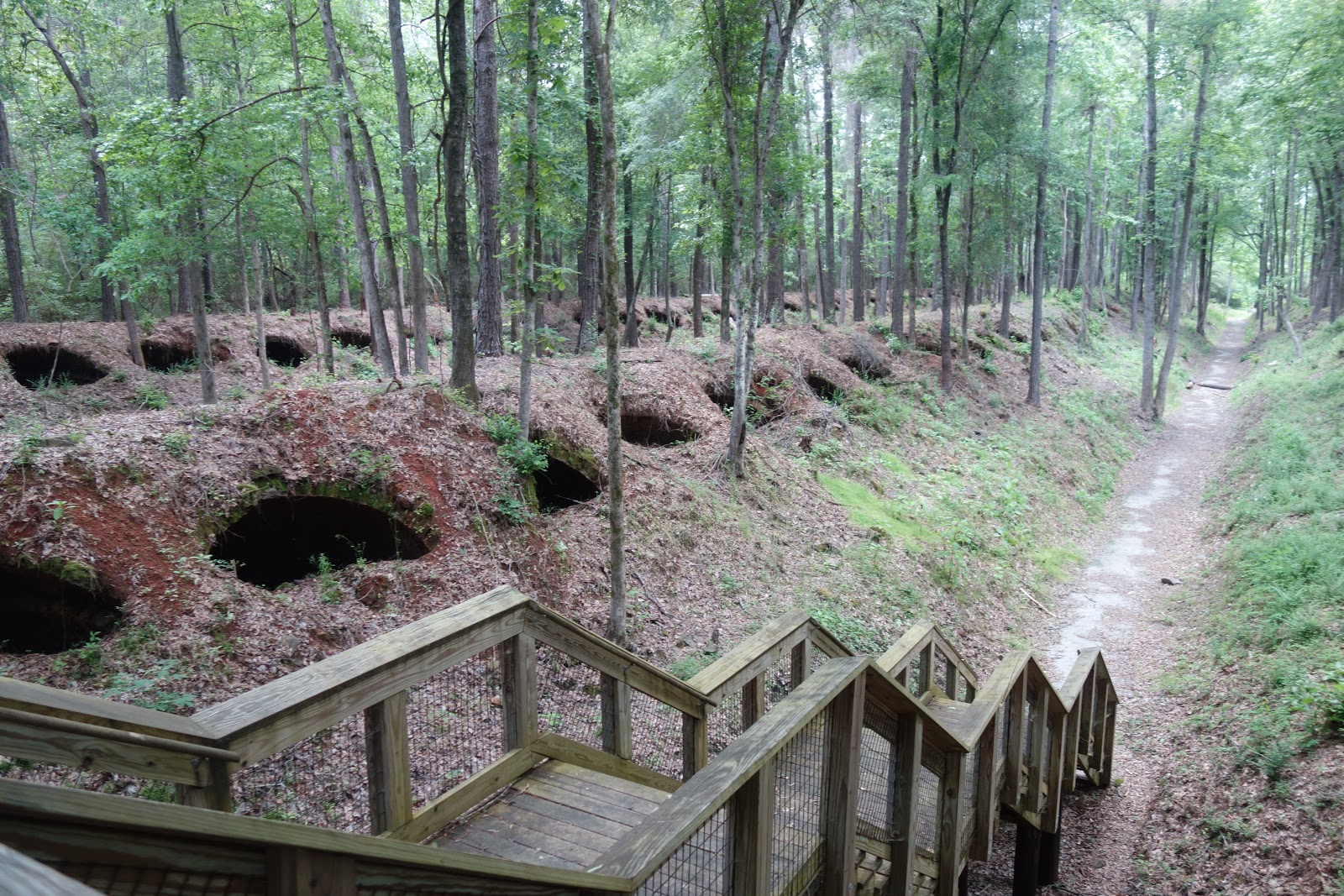
I came across this great little park on the way back from the Cahaba River National Wildlife Refuge, about 45 minutes southwest of Birmingham, AL. The West Blocton Coke Ovens Park combines ruins, history, and nature – perfect! It is a free park where you can roam and explore at will. There are facilities (restrooms, a large picnic pavilion, and a playground), but the highlight is the coke ovens themselves interwoven with trails and boardwalks.


Beehive coke oven interior. The extreme heat created a glaze on the bricks.

The trails include instructive signs covering the history and technology of this Cahaba Coal Company facility which was built in 1887 and produced coke from coal mined nearby.  The coal was loaded into the tops of the beehive block ovens and heated to 2800 °F to remove impurities, leaving the better burning, almost pure carbon, coke for use in the iron and steel industry.


Rail cars were used on top of the oven rows for loading the coal, as well as between the rows for moving the finished coke.


Coke ovens rail car on display in the park

View between rows from the elevated boardwalk

Interior of another coke oven with the top-loading hole visible

Lower boardwalk

One side of a double-sided row of ovens

The four rows of ovens (two double-sided and two single-sided) could produce 600 tons of coke per day. The facility only ran at capacity for about 20 years and there are no records of production after 1909. The 467 ovens are now in various states of ruin.


Bricks have fallen from the ceiling of this oven

End-buttresses on the south side of the facility

Unfortunately, in the 1980’s many of the end-buttress stones were removed from the north side of the facility to reconstruct an iron furnace at the historic Tannehill Ironworks. This has contributed to the degradation of the ovens, along with the many trees now growing on top of them.


Collapsed ovens on the north side of the facility

Walking through the park and getting a close-up look at these historic ruins is so much fun!